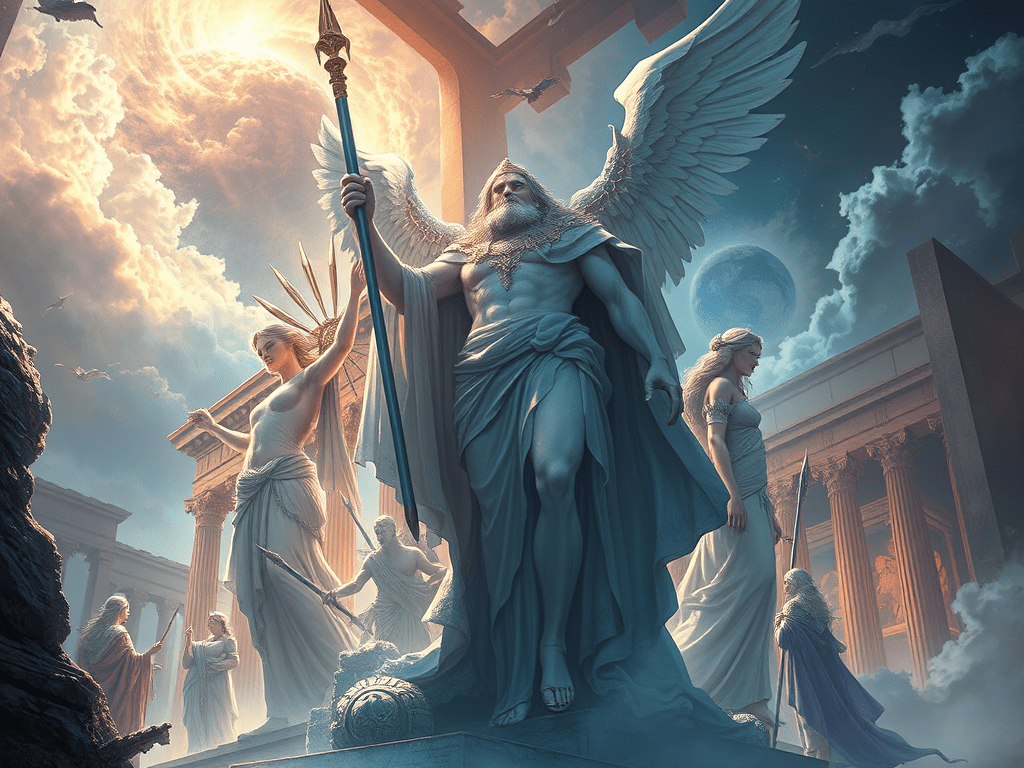
Greek mythology Pt.1: THE BEGINNING

Fall of The Titans: Zeus vs. Kronos
The generation of Kronos and siblings was known as The Titans. They were born from primordial beings and no longer considered primordial themselves, now that personalities, character, and form were developing and evolving into something more complex.
Kronos was now ruler of the world, as he had defeated his father Ouranos, and his mother Gaia had retreated into hiding. Kronos ruled along Rhea, who had children together. Their first was Hestia.
But Kronos was terrified of his children growing up and someday overthrowing him, like he did to his own father. So Kronos decided that he would eat his children. As soon as Rhea gave birth to Hestia, he swallowed her whole.
Rhea continued getting pregnant and giving birth: Hades, Demeter, Poseidon, and Hera. Again and again, each baby was eaten alive by Kronos as soon as they were born. Rhea was extremely upset by this but also too terrified and helpless to stand up to Kronos. By her sixth pregnancy, she decided that she would have to trick him.
Shortly before her labor, Rhea pretended to give birth. And when Kronos came to her and demanded the baby, she handed him a fake. Afterwards, she secretly ran away to the island of Crete in which Amalthea, the she-goat, assisted her in childbirth. She named her newborn son Zeus.
Zeus was raised on the stranded island by the she-goat, Amalthea. He drank her goat milk. There were also many nymphs that helped raise him. Eventually, he grew up into a strong adult. His mother, Rhea, would visit him often and remind him of what a horrible monster his father was.
It was finally time to take revenge. Rhea’s friend, Metis, helped by concocting a toxic potion. Kronos was poisoned, followed by Zeus sneaking up and striking a boulder at him. Out came all of his children he had eaten, but in reverse order: Hera, Poseidon, Demeter, Hades, and lastly Hestia.
While Zeus had been the last born, he was now technically considered the firstborn. Thus became a new generation of deities who no longer called themselves “Titans,” but rather, “the gods and goddesses.”
Titanomachy – The Great War

“Titanomachy” is the name of the Great War between the Titans, Gods, and Monsters. It was a bloody massacre that lasted ten years. Zeus casting vengeance on his father, Kronos, and bringing his five siblings back to life was only the beginning of what was to come.
We don’t know many details about what happened specifically during this war. All we know is that it caused lasting destruction on the planet – earthquakes, fires, formations of new islands, and the shifting of continents.
The Titans were stronger, more primitive and ruthless. And they outnumbered the gods and goddesses. But the gods and goddesses had the monsters on their side, giving them an edge. And Zeus felt that it was his destiny to overthrow his father and take rulership of the world.
All of these environmental shifts also caused the land to become fertile, lush, and green. The wildfires allowed the soil to become rich in nutrients, bringing more growth of plants and trees.
The world essentially evolved from 2D into 3D, as new gods were born with deeper and more complex personalities, and creatures became more unique and unpredictable. Think of a computer that has software upgrades, with evolving technology that puts the graphics in higher resolution. This is what was happening to the world!
The Muses
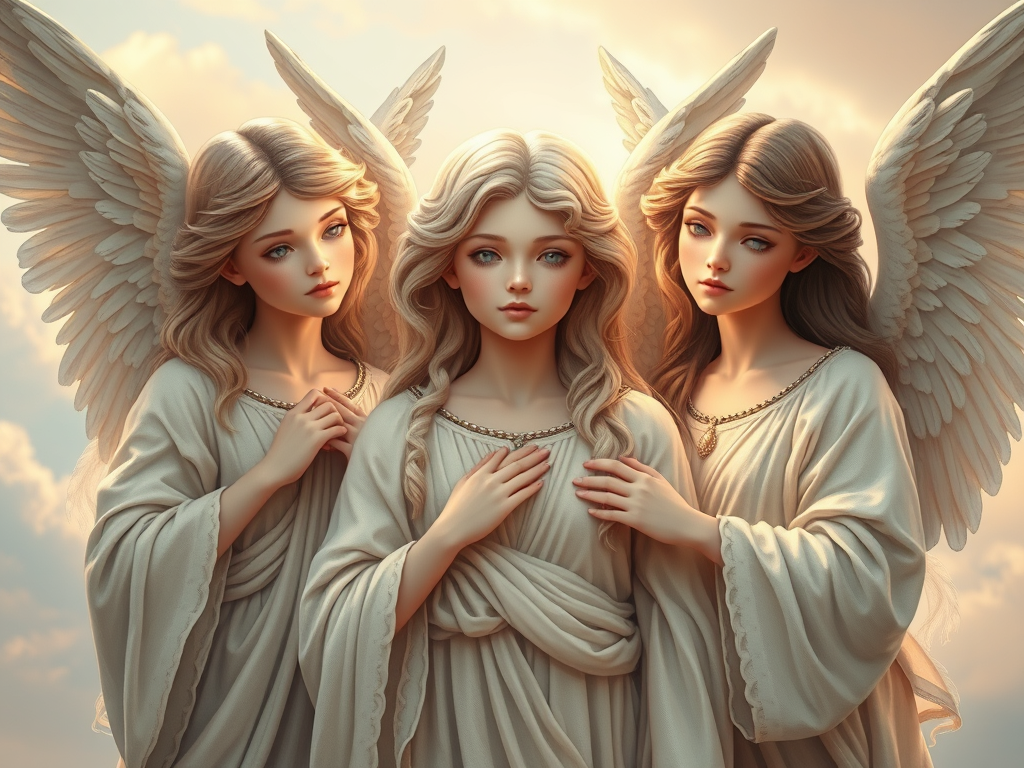
There was some mingling between the Gods and the Titans. Mnemosyne (Memory) was a Titan who had nine babies with Zeus. They were known as The Muses, as they were artistically gifted.
- Calliope: Muse of epic poetry.
- Clio: Muse of history.
- Erato: Muse of lyric and poetry.
- Euterpe: Muse of music.
- Melpomene: Muse of music, poetry, dance, celebration, drama, and tragedies.
- Polyhymnia: Muse of hymns, sacred music, dance, poetry – also agriculture, pantomime, geometry, and meditation. Seen as a more serious figure.
- Terpsichore: Muse of dance.
- Thalia: Muse of comic arts and idyllic poetry. The funniest and friendliest Muse of all.
- Urania: Muse of astronomy and the stars. A figure of “Universal Love” or “Holy Spirit.”
Trios
The Muses totaled as 9, which comes from 3 x 3. The number “3” is common (and sacred) in Greek Mythology. There are many famous trios.
The Charities (Three Graces)
During the Titanomachy (Titan war), Zeus had another affair with Eurynome (an Oceanid, daughter of Oceanus and Tethys.) They had three daughters: Aglaea, Euphrosyne, and Thalia. (Note that Thalia shares the same name as one of the Muses.) The Charities are also known as “The Three Graces.” They were known for being incredibly sweet and kind – against the cruel nature of the world.
Horai (Hours)
Born from Themis, these were two sets of triplet sisters. Auxesia and Carpo embodied the seasons winter and summer, while Thallo (or Flora in Roman) was the bringer of flowers and blossoming spring. The other set of triplets represented law: Eunomia (legislation), Diké (justice), and Eirene (peace – also Pax to the Romans.)
Moirai (Fates)
The Fates are often depicted with a spinning wheel and thread. Daughters of Nyx, their names are Clotho, Lachesis, Atropos. Clotho spins the thread, Lachesis measures it, and Atropos cuts it at the end. The thread resembles a person’s life, as the Fates are said to have complete control over everyone’s fate – even the gods!
Clotho can be seen as the initiator, determining when one’s life begins, or when important life events begin. Lachesis, who sits in the middle, helps determine the direction that one’s life will go. And Atropos determines when one’s life ends – most notably whether or not it will be cut short.
Keres
Also daughters of Nyx, this trio is far more sinister. They can be compared to the Valkyries of Norse mythology, but much more cutthroat. Drawn to violent deaths on battlefields, they sucked blood from each corpse until it was completely dry before moving onto the next.
Gorgons
Gaia and the primordial sea god, Pontus, had a son and daughter together: Phorcys and Ceto. The son and daughter then gave birth to three daughters of their own: Stheno, Euryale, Medusa. The Gorgons had snakes for hair, along with intimidating eyes and sharp teeth. Anyone who looked them in the eye would be turned to stone. Of course the most famous of the three proves to be Medusa.
Nymphs
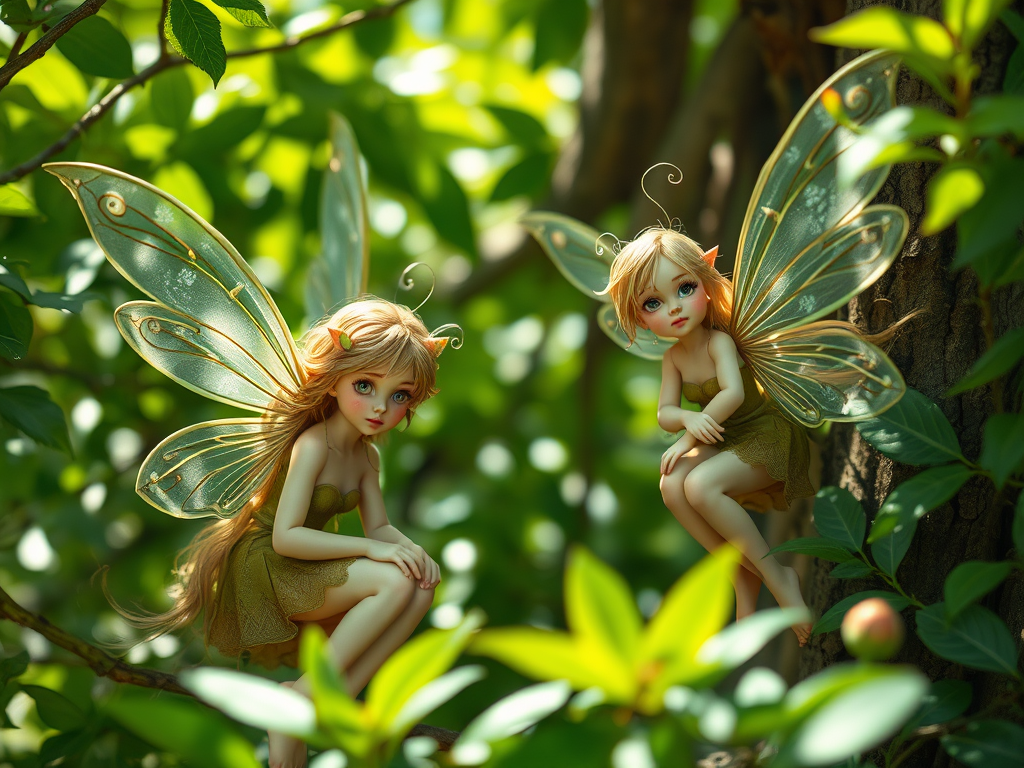
While new creatures and characters were evolving and growing during the Titanomachy, alongside came the birth of nymphs. Nymphs are female sprites who thrive in nature. They become bound to their environmental element.
- Nereids: deep ocean water nymphs.
- Naiads: freshwater nymphs (lakes and running water.)
- Pegaeae: natural spring nymphs
- Potameides: river nymphs.
- Auloniades: pasture nymphs.
- Leimakides: meadow nymphs.
- Dryads: woodland nymphs.
- Hamadryads: tree nymphs.
And these are only a few examples. Some nymphs were much more specific than others, for example nymphs who only belonged to a chestnut tree and no other type of tree. And if the chestnut tree was cut down, then the nymphs would die with it.
Nymphs will not migrate from place to place – they remain bound to their home. This brings a whole new layer to the protection of the environment. When a forest is destroyed, the nymphs of that forest are also destroyed. When a river is polluted, the nymphs will also get sick and die.
Aftermath of The War
Finally, the gods and goddesses had won the war against the Trojans with Zeus as their leader. Zeus did not punish the entirety of the Trojans, as some of them were spared. For example, Prometheus was a Titan who gained a friendship with Zeus.
However, his greatest enemy during the war had been Prometheus’s brother, Atlas. As punishment, Atlas was sentenced to separating the Earth and the Heavens by carrying the weight of the world on his shoulders.
Of course, his father, Kronos, would also be given an incredibly harsh punishment. He was ordered to spend the rest of eternity counting eternity – keeping track of the hours, days, and minutes. Kronos would be left stranded to roam the Earth, counting time, and essentially keeping track of time.
Kronos can be seen as “Old Father Time.” His name can be seen in the words “chronic,” “synchronized,” and “chronicles.” Although Kronos seems to disappear from mythology at this point, his presence remains for eternity, and you can feel him every day. Kronos is here when you are checking the clock, when you are rushing to make it to work on time, when you are counting the hours until your shift is over, when you are celebrating your birthday, when you are adding plans to your calendar, when you are feeling yourself growing older.
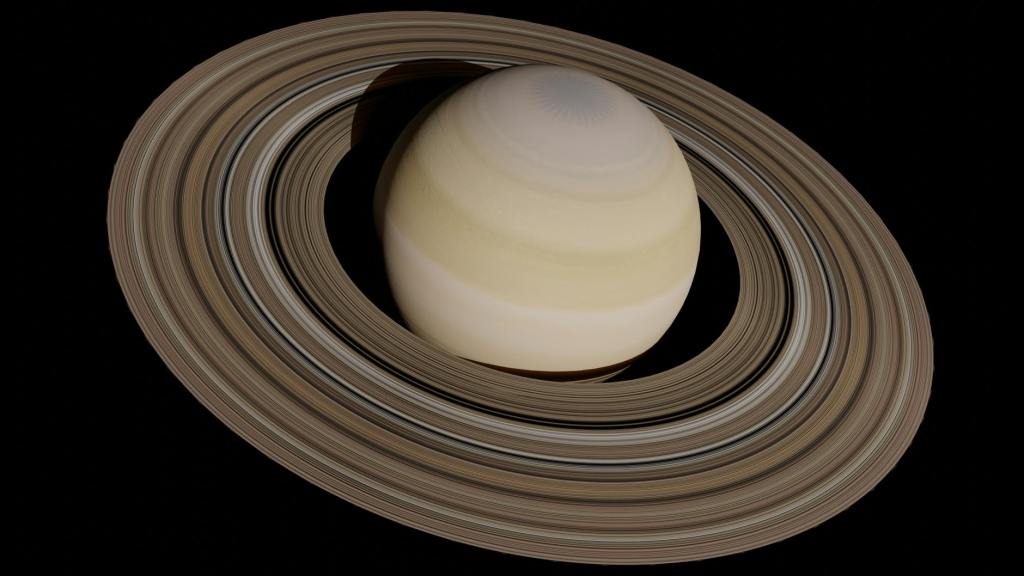
In Roman mythology, Kronos can be compared to Saturn. And in our solar system, Saturn (Kronos) sits between his father, Uranus (Ouranos), and his son, Jupiter (Zeus.)
Part 3 coming next…






 Crystal Aura Gaze
Leave a comment