
The Egyptians followed their calendar based on the sun: 365 days a year divided into twelve months.
But according to Egyptian mythology, the world was originally created as 360 days. The five extra days were added on during the birth of the gods.
Geb (the god of Earth) and Nut (goddess of the sky) wanted to be together, but Ra (god of the sun) made it forbidden. And Nut was not allowed to give birth any time of the year.
Thoth (god of wisdom and magic) helped by making a plan to trick Ra and allow Nut to give birth. He gambled with the moon which allowed him to steal more light for a longer year. This added five extra days.
This loophole is what allowed Nut to give birth to her five children: Osiris on day 1, Horus the Elder on day 2, Set on day 3, Isis on day 4, and Nepthys on day 5. These gods were very prominent and powerful throughout Egyptian mythology.
In ancient Egypt, these days were celebrated as the gods’s birthdays. They would perform rituals and dedicate each day to that specific god/goddess. These five days were considered chaotic and disorganized, even unlucky, because it symbolized five extra days that were not supposed to exist.
The ancient Egyptians marked the start of the new year by the rising of Sirius, which date has shifted over the millennium. They also did not account for leap days. This makes it difficult to determine exactly when the Epagomenal Days would fall on a modern calendar. I’ve seen many dates, but it tends to be the third or fourth week of July. It was celebrated in the final five days of the year, so that could also translate to December 27-31.
In Kemetic Paganism, in which the ancient Egyptian religion is reconstructed, many celebrate the Epagomenal Days. Each day corresponding to each god’s birthday, you can give an offering or prayer to that god. Not only is this seen as a way of honoring the gods on their birthdays, but also keeping the universe in order and avoiding chaos during these five extra days that were added to the year according to the myth. So, it can be seen as superstition and protection.
The five days that people may celebrate this can vary due to the inability to convert ancient timing to today. Most commonly, it will be observed at the middle or end of July. If you are going by the rise of Sirius, as it was originally followed, you may still find varying dates but typically anything from July 19 to August 17. But if you following the aspect of it being the last five days of the calendar year, then you may choose the last five days of December. Also, an extra day should be added for leap years.
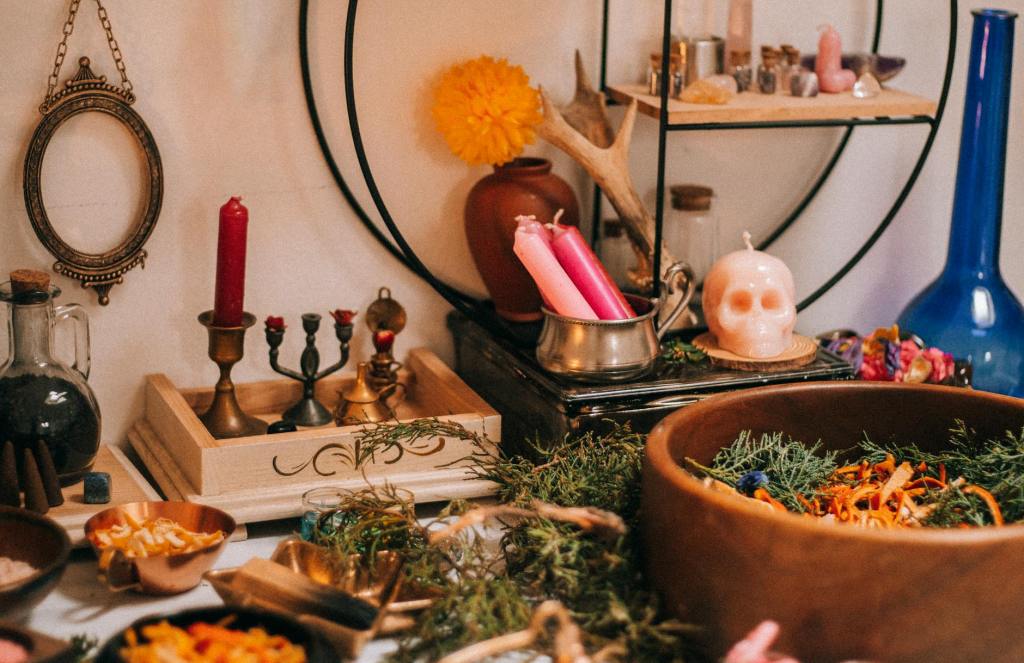
I decided that this year I would observe this ancient holiday. I followed guides from the book “Circle of the Sun.” Each night, I lit a candle and rang a bell and spoke prayers from the book that is sourced from ancient Egyptian texts. I had water, milk, a piece of bread, and incense for my offerings (essential oil spray instead of burning incense because I live in an apartment and scared of setting off the smoke detector.)
My cat Luna surely loved this, because I gave her my little cup of milk each time. This was a cool experience; the first day or two was a little hard to get into but by the fourth and fifth day, I felt an exciting feeling in my heart like maybe there was some magic happening here.
Happy new year! 😉





 Crystal Aura Gaze
Leave a comment