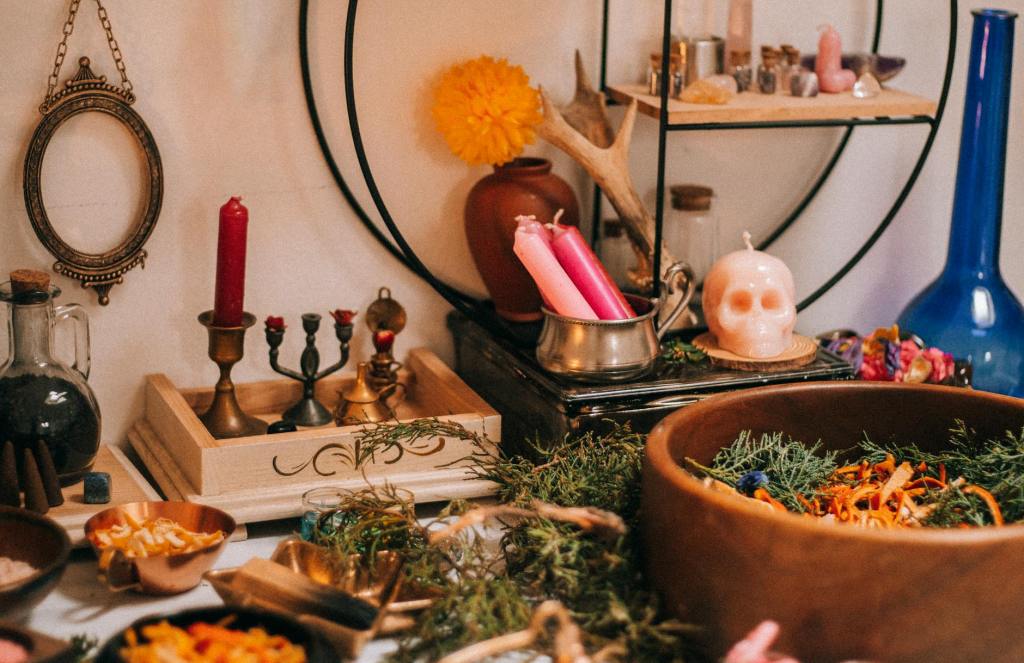
Paganism has A LOT of holidays!
I will be going over the holidays (Holy Days) – specifically for Paganism and Wiccan, Hellenic (Greek,) Roman, and Kemetic (Egyptian). I will not be listing every single one because that might be impossible, considering how many holidays there are. There are also so many more branches of Paganism, but I will only be focusing on these specific branches.
In Paganism, celebrating holidays is a great way to bring your spirituality into life. Reading, learning, and researching the religion is only one part. Actually putting it into practice is what gives it material form.
How to celebrate?
How do you celebrate a pagan holiday? There are many, many ways. You do not have to throw a party or have a big social gathering – but you can if you want to. Holidays can be completely solitary – in which you pray or recite hymns and poems at your altar.
Holidays can be something that you do with your family, if you have kids, and you could even include your pets. You can celebrate with online communities or make a post about it on social media.
Baking or cooking is a great way to celebrate – and you can share the food with friends and family who don’t celebrate. In nice weather, you can go out for a walk or spend time in nature with intention to celebrate this specific holiday. You can also do arts and crafts or make a devotional playlist.
For each section, I will provide some books that will help you learn more about the holidays and get more ideas about how to celebrate them.
Wheel of the Year
Paganism is such a broad spectrum – I’m going to begin with general paganism, or “neopaganism,” and also Wiccan. No matter how varied your beliefs or practices are, The Wheel of the Year is something that nearly all neopagans celebrate. And the holidays are simple and concrete, so it really is the best place to start if you’re new to this.
Note that the term “paganism” and “neopaganism” are essentially the same thing – the difference that that neopaganism puts more emphasis on the fact that this is a modern reconstruction of ancient practices. Learn more about this here.
The Wheel of the Year is a modern practice – but it’s based on real, ancient observances. It blends multiple cultures and traditions together, yet certainly has a strong Celtic influence. The Wheel of the Year can unite all pagans together, no matter which branch you focus on.
The foundation of the Wheel of the Year is about paying attention to nature and honoring the cyclical ways of life. The dates come from the quarter points of the changing seasons.
Northern hemisphere dates: (Southern hemisphere uses opposite dates.)
- December 21st: Yule
- February 1st: Imbolc
- March 21st: Ostara
- May 1st: Beltane
- June 21st: Litha
- August 1st: Lammas
- September 21st: Mabon
- October 31st: Samhain
Yule marks the start of a new year in which a seed is planted. It’s the turning point in which the light begins to grow. On Imbolc, you begin to see the light growing, and you nurture the seed. Ostara marks the first day of spring, in which the seed sprouts and the light takes over. Beltane is halfway between spring and summer, when the flower has bloomed.
June 21st is the halfway point between the entire year – the peak of our growth. From here, the darkness starts to rise, and we begin to turn inwards. On Lammas, we celebrate the harvest and all of our accomplishments of the year so far. Mabon marks the point in which the darkness is taking over. And on Samhain, the veil into the other side is at its thinnest, and the yearly cycle comes to a close. It symbolizes the death and rebirth of our souls.
The wheel of the year is not simply about nature – but the spiritual and symbolic energy that the turning of the seasons holds. Our time of growth, energy, and pushing outwards is just as important as our time of rest, reflection, and introspection.
Books
- Llewellyn’s Sabbat Essentials (8 book series)
- The Wheel of the Year: An Illustrated Guide to Nature’s Rhythms
- Paganism: An Introduction to Earth-Centered Religions
Ancient societies
As we move into the ancient society holidays, things become a bit more complicated. It can feel very overwhelming at first! It’s perfectly fine to stick with The Wheel of the Year. But if you want to go deeper, you may want to follow these too.
Religion in ancient societies focused on their specific deities. The moon cycle also plays a lot of importance.
Ancient Greek (Hellenic)
In the Ancient Greek religion, there are Lunar holidays (celebrated once a month) and Annual holidays (celebrated once a year.) The day begins at sunset and the year begins in June/July.
Lunar holidays
In Athens, they followed the Attic Calendar, which goes by the moon cycle. A new lunar month begins approximately 2-3 days after the New Moon, when the first crescent sliver is first visible in the sky. You can download an app on your phone to help you follow this calendar.
The most important days are the last, first, and second days of the lunar calendar. The month may be 30 days or 29 days long.
- Day 1: Noumenia
- On the first day of the lunar month, approx 2-3 days after the new moon. Noumenia is the most holy celebration in the Greek religion. All household gods (Hestia, Zeus, Apollo, etc.) are honored. Honey cake can be made as an offering.
- Day 2: Agathos Daimon
- Agathos Daimon is the spirit of the household – symbolized as a snake. This spirit is personal to everyone and each household has their own spirit.
- Day 3: Athena
- Day 4: Aphrodite, Heracles, Hermes, Eros
- Day 5: inauspicious day
- The fifth day is not devoted to any god or spirit; and you should be cautious on this day.
- Day 6: Artemis
- Day 7: Apollon
- Day 8: Poseidon
- Day 9: Helios, the Muses, Rhea
- Day 15 or Full Moon: Selene, Artemis, Hekate
- Day 18 and 19: Cleansing & purification
- 3-4 days after the full moon is dedicated to cleansing yourself and preparing for the upcoming new moon.
- Day 29 or 30 – Last day: Hekate’s Deipnon
- One of the most important days, it comes 1-2 days after the new moon, the day before it is first visible. This day honors Hekata and the spirit world.
The days aside from 1, 2, and 29/30, may be devoted to a god or multiple gods. Those days
Annual holidays
There are many, many annual holidays – so I will only go over a few. The timing of holidays is very tricky because their lunar calendar system makes it hard to accurately translate to the current calendar we use today.
You can download the Attic Calendar app to help you follow along more accurately. But not every pagan or Hellenic chooses to follow the attic calendar. Because of this, I can only give estimates for dates. There is flexibility to observe a holiday when it makes most sense to you personally.
- Early February: Lenaia
- A 4-day festival for Dionysos
- Late March: Lesser Eleusinian Mysteries
- 2-3 days; start of spring.
- Early spring: Anthesteria
- 3-day festival of flowers.
- Late March/early April: City Dionysia
- Honoring Dionysus; focus on theater, music.
- Summer: Aphrodisia
- The 4th day of Hekatombaion, but can be celebrated at any point in the summer. Honoring Aphrodite.
- Mid-August: Panathenaia (Athena’s birthday)
- 7-day festival, Day 23-29 of Hekatombaion, or any point in late summer.
- Late September: Greater Eleusinian Mysteries
- 9 days; start of autumn.
- Late October: Thesmophoria
- Woman’s festival in honor of Demeter and Persephone, honoring Demeter’s search for her daughter. Men are not permitted to participate.
- Mid December: Country Dionysia
- Honoring Dionysus; focus on fertility, nature, ecstasy.
Books
- The Orphic Hymns
- Homeric Hymns
- Hellenic Polytheism: Household Worship
- Hellenismos: Practicing Greek Polytheism Today
Roman
Ancient Romans had the MOST holidays! Nearly more than half of the year composed of holidays – sometimes happening 2-3 days per week. Holding festivals and ceremonies was their preferred mode of spirituality.
Dates are much more accurate because they implemented the Julian Calendar in 45 BC, which is much more similar to our current calendar, in comparison to the Ancient Greeks.
- January 1st: Janus
- Honoring Janus, the 2-headed god (who January is named after!)
- Early January: Compitalia (the Lares)
- Household spirits
- Feb 5th: Concordia
- Goddess of harmony and balance.
- Feb 13th: The City Faunalia
- (Greek: Pan)
- March 1st: Birthday of Mars
- April 1st: Veneralia (Venus)
- April 4-10: Megalesia
- Honoring The Great Mother
- Late April: Cerealia
- May 15th: Mercuralia
- June 1st: Feast of Juno
- June 7-15: Vestalia
- June 24th: Fors Fortuna
- July 6-13: Games of Apollo
- July 23rd: Neptunalia
- August 12th: The Lamp-Lighting
- Roman festival for the Egyptian goddess, Isis.
- August 23rd: Vulcania
- (Greek: Hephaestos)
- August 24th: Day of Victory
- (Roman: Victoria; Greek: Nike)
- Sep 13th: The feast of Jove, Pt 1
- Jupiter
- October 15th: October Mars
- The Romans love Mars so much that he gets two annual holidays.
- Nov 13th: Feast of Jove, Pt II
- Jupiter also gets two annual holidays.
- Dec 5th: The Country Faunalia
- Dec 17-23th: Saturnalia
Books
- A Year of Pagan Prayer: A Sourcebook of Poems, Hymns, and Invocations from Four Thousand Years of Pagan History
- The New Vesta Secret: Finding the Flame of Faith, Home & Happiness
You can also take inspiration from The Orphic Hymns and Homeric Hymns – although they are Greek, there can be overlap between Greek and Roman deities.
Egyptian (Kemetic)
The Ancient Egyptians had their own calendar system – but it was most identical to today’s current calendar, in compared to other ancient societies. They followed a solar calendar, like we currently do, with 365 days a year.
However, the twelve months had thirty days each – leaving five extra days at the end of the year known as “Intercalary days.” The only issue with this system was that there was no leap year or anything to make up that 0.25 extra day, eventually causing disorder.
The new year began in mid July – with the annual flooding of the Nile river. But for the sake of keeping consistency with modern dates, I will begin with January.
Annual holidays:
- Jan 4th: Feast of Victory
- Celebrating the defeat of Seth
- Jan 13th: Feast of Lifting Sky
- The mid-year of the Egyptian calendar.
- Apr 13th: Feast of Min/Rennutet/Khnum
- Apr 28th: Feast of the Valley
- Veil between living and dead at its thinnest.
- May 20th: Feast of the Reunion
- May 27th: Feast of Neith
- June 12th: Feast of Apip
- July 12th: Day of Mosyt
- July 13-17: Days Upon the Year
- Takes place during the five extra days on the Egyptian calendar.
- Deities celebrated for each day: Osiris, Horus, Seth, Isis, Nephthys
- July 18th: Upet Ronpet
- New Years Day
- Aug 3-5: Wagy-Djehutet
- Osiris and Anubis
- Aug 31-Sep 10: Opet Festival
- Oct 16th: Sailing of Hathor
- Oct 27-Nov 14: Feast of Sokar/Khoiakh Mysteries
- Honoring the dead
- Nov 15th: Has Sed/Feast of Neheb-Kau Coronation of the Sacred Falcon
- Dec 14th: Sailing of Mut
The Ancient Egyptians also followed the moon cycle very closely. They did ceremonies for each moon phase (which you can do at home by yourself.)
Moon cycle:
- Pesdjentiu (New moon)
- A’bed (First crescent)
- Senut (Sixth day feast)
- Medj-diunit (Full moon)
- Denit (Last quarter)
- Peret min (last crescent)
Books
- Circle of the Sun : Rites and Celebrations For Egyptian Pagans and Kemetics
- Following the Sun: A Practical Guide to Egyptian Religion
- The Complete Gods and Goddesses of Ancient Egypt



 Crystal Aura Gaze
Leave a comment