Lots of mystery surrounds ancient philosopher Pythagoras. In modern times, we best know him from math class by the “Pythagorean theorem” — yet his legacy is far more mystical than what we were taught in school.
Existing around 500 BC, there are limited reliable sources on his life, and some conflicting claims. Yet due to his significant impact on the world, there is still plenty of information available. Most likely he was born somewhere between 600–570 BC. While some sources claim he lived into his late 70s, many others state that he lived to about 100-years old.
Pythagoras may have been the first mathematician, as well as the first man to call himself a philosopher (“lover of wisdom.”) It is said that he spent time in Egypt studying with priests and priestesses — it’s also said he studied from Persians, Hindus, Jews, Celts, and many more. Alongside, Greek education also made an impact on him.
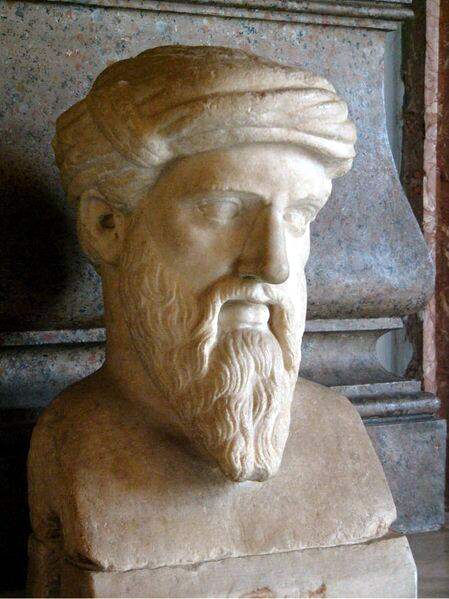
In 530 BC, Pythagoras moved to Croton (southern Italy) to form his own religious cult, or “mystery school.” To his followers, he taught vegetarianism and ascetic practices. Swearing them all to secrecy, there is no way for us to know the specifics of his teachings. However, the basics of his teachings are agreed on by all scholars…
Pythagoras was a strong believer in reincarnation, that after the body dies, the soul passes on to another human or animal. The soul resides in the brain, and the body is a tiny copy of the universe. He believed that this cycle carried on until the soul became pure. Vegetarianism and asceticism were examples of how he attempted to purify the soul. He also abstained from food and sex, living a celibate life and eating as little as possible — most notably avoidance of beans.
Also in his teachings, Pythagoras promoted isolation and straying from the crowd. He urged the importance and sacredness of silence, proposing that remaining quiet is preferred — that humans often speak of ignorance and evilness, and usually should hold their tongues. Peace and nonviolence is key.
When it comes to numbers and mathematics, Pythagoras saw them as more than a simple school subject — he saw numbers as ALL! The whole universe is composed of numbers. And he believed that each number came with its own personality — positive and negative traits — mystical and secretive meanings. Thus, Pythagoras ultimately gave birth to the esoteric practice of “Numerology.”

Later in his life, some sources say when he was 60-years old, Pythagoras married one of his disciples named Theano. The two had children together, possibly five to seven kids. She was about 20-30 years younger than him. Although there is no concrete evidence, it is strongly supported that she was the first female mathematician, and first to write about the “golden ratio.”
Very different from Italian culture during this time, Pythagoras’s school supported equality of men and women. And so, it makes sense that female Theano was given opportunity to display her intellectual abilities, and further advance her knowledge. After the death of Pythagoras, Theano continued to teach his mystery school.
The details of Pythagoras’s death is blurry, with many conflicting accounts — however most sources agree that is was assassinated. It is likely that his sacred knowledge was threatening to others, or that many were envious of his power and influence, or perhaps those who were not accepted into his school sought revenge.
Pythagoras was indeed a mathematical genius and philosophical extraordinaire. Many of his beliefs were likely not original to his own mind, but the absorption of ancient Egyptian religion and a mix of sacred teachings from other cultures. Concepts such as reincarnation, gender equality, and asceticism date back far before his time, and were not novel to his era. However, he is certainly one of the first to take these Eastern beliefs and introduce them into Western society.

It is amazing that so much of his legacy has survived to this day. And the craziest part is that everything that we know now is only the teeny, tiny tip of the iceberg.
Sources:
- https://www.worldhistory.org/Pythagoras/
- https://en.wikipedia.org/wiki/Pythagoras#CITEREFFerguson2008
- https://www.mathopenref.com/pythagoras.html
- https://www.sacred-texts.com/eso/sta/sta15.htm
- https://biography.yourdictionary.com/theano
- https://www.agnesscott.edu/lriddle/women/theano.htm
- https://kids.kiddle.co/Pythagoras








 Crystal Aura Gaze
Leave a comment