The “Pennsylvania Dutch” refers to the group of people who migrated from modern-day Germany to the United States and Canada (primarily Pennsylvania) during the 1600s and 1700s. They had a rich tradition of folklore, often passing down stories orally from generation to generation. The following tale comes from the book “Folk Tales of The Pennsylvania Dutch: Stories of Witchcraft, Magic, and the Supernatural” by William Woys Weaver.
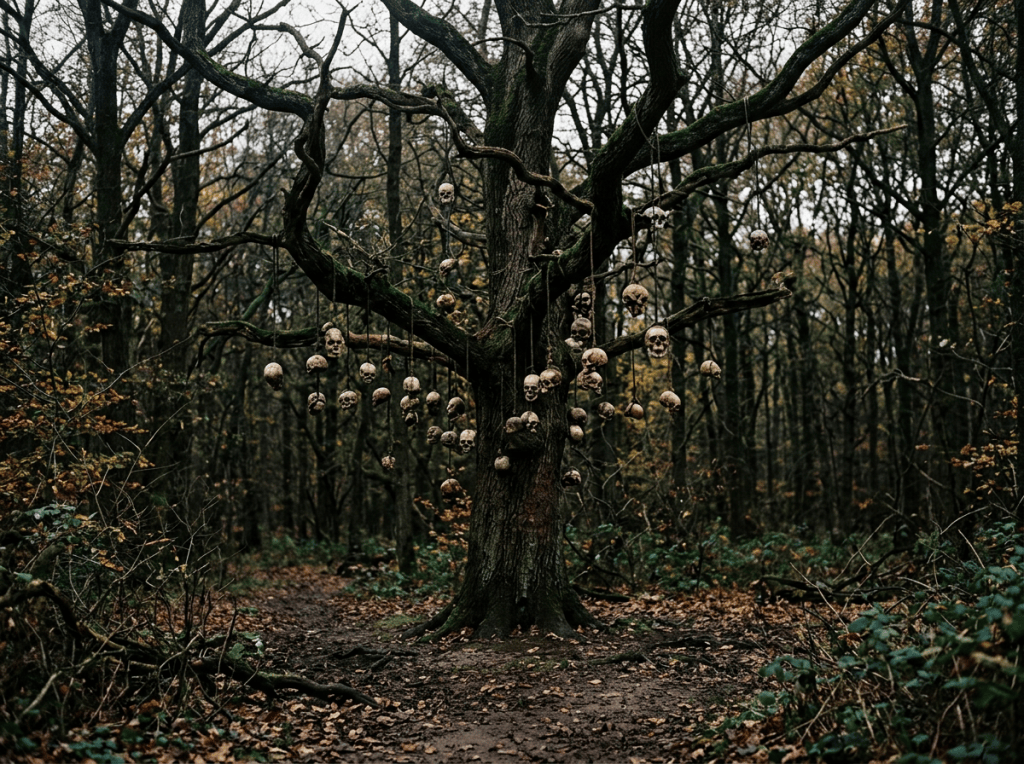
There once was an ancient apple tree located in Hexenkopf Ridge, Northampton County, Pennsylvania. It had been originally planted to mark the corner-point of a colonial property. The tree stood in a traffic circle, nailed with hand-painted signs, to mark the directions of different villages.
When the yellow apples were plucked from the tree, they tasted absolutely delicious. However, if the apple had naturally fallen off the tree, and was eaten from the ground, it became deadly.
As a way of warning others about the poisonous apples, the skulls of the heads from those who had been poisoned were hung from the tree branches. Some of these skulls were human heads, while many were horse skulls, as the horses were more likely to eat the fallen fruit. There were even a few sheep skulls and horned cattle skulls.
The ministers in the area were offended by the gruesome appearance of the skull tree – even though the skulls served as a humble and cautious warning of protection. One day, a surplus of human skulls began showing up on the tree, far more than the animal skulls – and that was the final straw for the ministers.
The ministers came together in fury and declared that there must be witchcraft taking place in this area. It was the only explanation for the sudden uprise in human skulls hanging on the tree. If not witchcraft, then there must be pranksters implying so. Regardless, they agreed that the tree needed to be cut down and removed.
A committee of men got together to remove the tree. One man started off by cutting a hole in the tree to create a plug in which they would replace the sign with directions to the other villages. But as he put a hole in the tree, blood began to drip out.
Shocked, the man stepped back in fear, as the rest of the group froze.
But one man, Henner Zierfass, threw a rock at the tree and shouted, “Wake up Hexebaam (witch tree), we are here to remove your curse. A Braucher (a Christian folk healer) will come and turn you into sawdust!”
“Then that is no true Braucher,” a voice from the tree replied. “There is no evil in this tree other than what has been laid upon it by witches at Hexeschtee. I would love to meet your Braucher and have this evil curse removed from me so that I can be free. But first, you must stop the blood, because it’s flowing from a victim at their rock up north. The rest of their victims were already killed during their sabbath.”
“Who speaks?” Henner questioned, staring blankly at the tree.
Coming from the tree was a supernatural being known as the Ebbelmops, an apple dwarf who dwells in an apple tree and represents its spirit. In animal form, it turns into a benevolent black and white snake.
And so, in snake form, the Ebbelmops slithered from out of the tree and announced, “I am the unhappy soul that is bound to this cursed tree. Now, send me the Bracher who will remove this curse. If not, the fairies who dance around my tree every night will come for all of you with revenge.”
“Revenge?” Henner defended, “we have done nothing to inflict this curse. We are not to blame.”
The snake protested, “you have turned a blind eye to the evil that this tree has inflicted and dismissed it as a way of life. This tree has taken innocent lives for how many years now? Each and every one of you is guilty.”
The man plug up the bleeding hole from the tree and the group retreated back into the farmhouse to discuss what they would do next.
The farmhouse door burst open, and there was Braucher Pappi Henk with an apple in his hand. “The tree has given me the last of its fruit. There is heavy hurt buried deep in that bark. You should be ashamed to think that an ax would solve the problem. Should I cut off your leg to cure your broken heart?”
And so, the Braucher Pappi went to the tree and called upon it to give up its wounds and the means by which the witches had entered into its happiness. The snake came down in appreciation and gave specific directions, “with my last apple in your hand, drive an iron nail through it, cast it into a pit filled with raw stinking dung, and then command it to fly to the Hexeschtee and drown it in fire.”
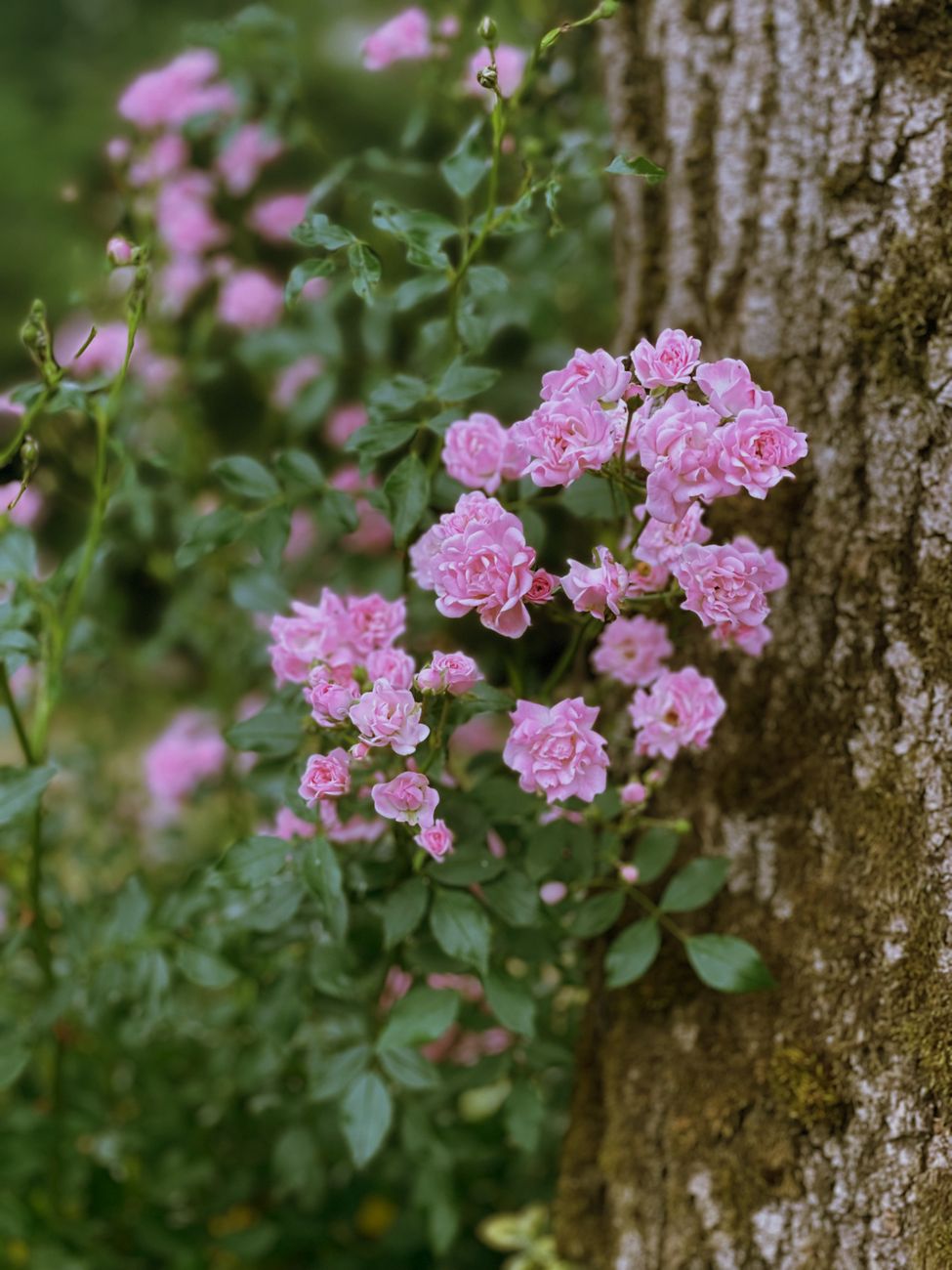
Carefully following directions, the curse had now been lifted. One by one, skulls began to drop from the tree. And once the last skull had fallen, the tree blossomed with pink roses. The scent filled the forest. And the new apples growing from the tree were now called Rose Apples.
Since then, the old tree has withered away from old age and naturally disappeared on its own. The tree is said to be located in Kistler Valley, while some say it was at the intersection near Stein’s Corner. To this day, Hexenkopf Rock is a well-known witchcraft site.
This folktale has an unexpectedly deep message. The Braucher makes a very valid point when it comes to turning a blind eye to evil. Just because you did not cause the evil, does not make you innocent. If you are a witness to evil and choose to do nothing about it, then it makes you just as guilty.
When the group of men finally decided to “do something,” their action plan was the cut down the tree with an ax. This is highly metaphorical. This is like fighting fire with fire, or fighting evil with evil.
It also represents refusing to look at the deeper issue. Instead of looking deeper into the wounds of the tree, they decided to simply cut it down. The Braucher’s quote, “should I cut off your leg to cure your broken heart?” speaks volumes.
When we deal with problems in life, especially acts of injustice, we fixate on the surface and the physical aspect – rather than going within. Instead of fighting fire with fire, we should be focusing on healing.
The “poisonous apple” is a common theme in many folktales and fairytales. My first thought is “Snow White,” and I also think of the Biblical story of Adam and Eve and the tree of forbidden fruit, which is often depicted as an apple. Also, apples are primarily harvested in fall, which is the season of death.
Braucher is a common term that you will find in most Pennsylvania Dutch folklore. In PA Dutch history, Brauchers were real people who practiced folk healing through herbalism, superstition, and Christian faith.
We are introduced to a supernatural being known as: Ebbelmops. I was trying to find more information on this online – and I could not find anything at all! So just for proof, I am going to add a photo of the mention of this figure in the book (“Folk Tales of The Pennsylvania Dutch: Stories of Witchcraft, Magic, and the Supernatural” by William Woys Weaver.)
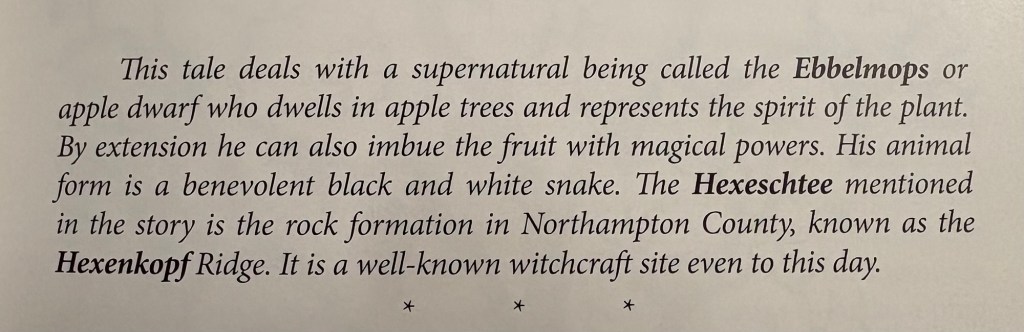
I am astounded that I cannot find any further information on this supernatural being online. I tried every search engiene and social media – and there’s nothing. This further shows the importance of books and the information that they hold. And it shows that the internet doesn’t know everything!





Leave a Reply