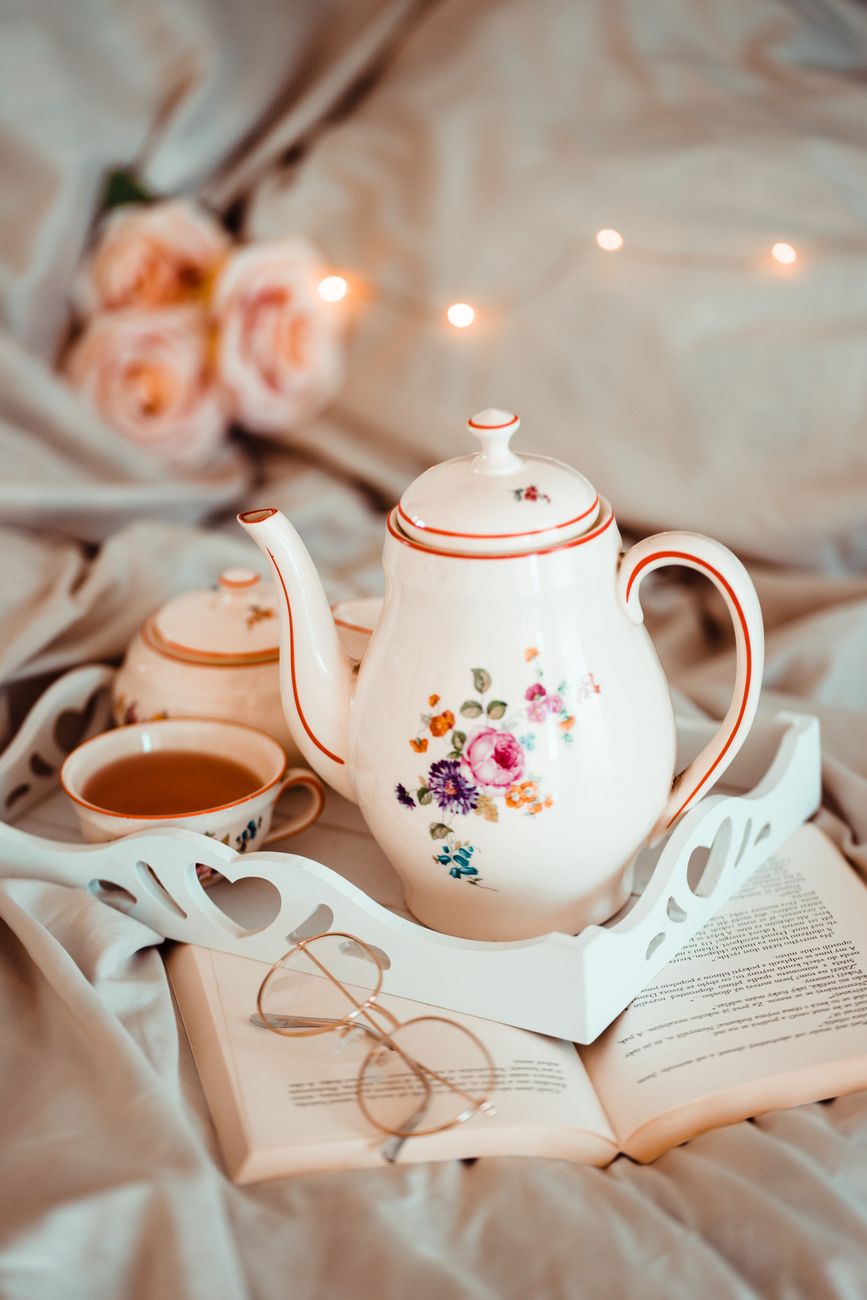
There is a whole lot more to making a cup of tea than you’d think! Recently, I took an online course on how to properly brew and formulate a cup of tea.
Note that in this context, I will be referring strictly to herbs / herbal tea (rather than black tea, green tea, etc.)

1. Loose leaf tea is superior over teabags.
Buying herbal tea in teabags may feel more convenient, but it is far less effective than loose leaf. The first reason is that most teabags are going to be used with older herbs that have therefore lost their potency.
Another reason is that bagged tea does not contain enough herbs. A serving of herbal tea should be about 1-2 tablespoons, while a teabag only contains about 1-2 teaspoons. That means that a teabag is only 1/2 to 1/3 the amount of a proper serving.
If you are making herbal tea from a teabag, you should double up and use two teabags. Even so, the potency will not be as strong or effective.

2. Herbal tea should be steeped for a minimum of 10 minutes.
When you read the directions on the box of herbal tea, they typically tell you to steep the bag in boiling water for about 2-3 minutes, maybe 5 minutes max. In reality, herbal tea needs a much longer time to steep.
You should steep herbal tea for a minimum of 10 minutes, but 15-20 minutes is even better. 30 minutes or more is fantastic, but at this point, your tea could be getting cold.
If possible, try to cover your tea while it is steeping. This is not always practical for most types of mugs, but if you want to steep your tea to the maximum, you should keep it covered.
Tea can also be steeped in cold water – this will probably take at least several hours to a day.

3. Infusion verses decoction…
Infusions are what we most commonly think of with tea. Infusions are done by letting the tea steep in hot or cold water for a certain amount of time. Next, the contents are drained and you are left with the infused water. This is ideal for leaves, flowers, and stems.
Decoctions are made by directly boiling the herbs in water and letting it steep for a minimum of 30 minutes. There are special pots that you can buy in order to do this more conveniently. This is done for roots, bark, seeds, rhizomes, and woods of the plant.

4. Consider energetic qualities: hot, cold, moist, dry.
Herbal tea is not just about flavor – it’s medicinal. When picking an herbal tea, you should consider any ailments you are currently dealing with, and how the herbs can help with that.
In herbalism, there are four energetic qualities: hot, cold, moist, and dry. For example, if a person is too “hot,” they should choose a “cooling herb” – if a person is too “moist,” they should choose a “drying herb.”
Energetics in humans:
- Hot: redness, fever, inflammation, itching, insomnia, restlessness, anxiety, irritability, anger.
- Cold: bruising, slow metabolism, paleness, constipation, lethargy, depression.
- Moist: runny nose, sneezy, sweaty, oily skin, puffiness, swelling.
- Dry: congestion, flaky skin, dehydration, sunburn, chapped lips.
For example, peppermint is a cooling herb. So if you are experiencing hot symptoms such as inflammation and anxiety, you would benefit from a cup of peppermint tea. While ginger is a warming herb – so if you are experiencing cold symptoms such as digestive problems, reach for a cup of ginger tea.

5. Tea recipes are made in “parts.”
A tea formula recipe usually uses the term “parts” rather than specific measurements. This allows you to control your batch size. Whether you want to make one cup of tea for yourself, a large batch in bulk to keep in your kitchen, or an extra large batch to sell, “parts” lets you decide.
A recipe may call for “2 parts of X herb, 1 part of X herb, 1/2 part of X herb.” This could translate to teaspoons, tablespoons, or cups.

6. Three-part formulation triangle of herbal tea…
If you are making a tea formulation yourself from bulk herbs, it’s best to follow the “three-part formulation triangle.” One herb is used as the majority for primary action, one herb is used as the minority for secondary action or catalyst, and another herb is used as the minority for catalyst or taste.
It’s best to use 2-3 different herbs in a formula. Using more than one herb allows more medicinal action while also giving an opportunity for a better and stronger taste. But anything more than three herbs, each herb may lose its power and potency.

This is really only the surface of tea making!
I really enjoyed doing a tea making class. As I’m well-versed in herbalism, a lot of the things I learned about herbs were refreshers. But to my surprise, there were many things about making a perfect cup of tea that I didn’t realize!





Leave a Reply